Reading napkin orders into the ordering system, with a human in the loop
Ventura, Summer 2025, later in Y Combinator (Winter 2026)
Guessing wrong costs a customer. I joined Ventura as its second person. By summer’s end, 15 industrial distributors were paying for our agent.
about $600,000 closed in three months, starting from an idea
Signed contracts only.
- Role
- Co-founder, product and go-to-market
- Team
- Two founders, then a chief technology officer I brought on and a small engineering team
- Timeline
- June to August 2025
- What changed
- From retyping orders all day to checking what the agent flags
In short
- A rep types every order, from faxed purchase orders to the odd napkin, line by line into the distributor’s ordering system, its enterprise resource planning (ERP) software.
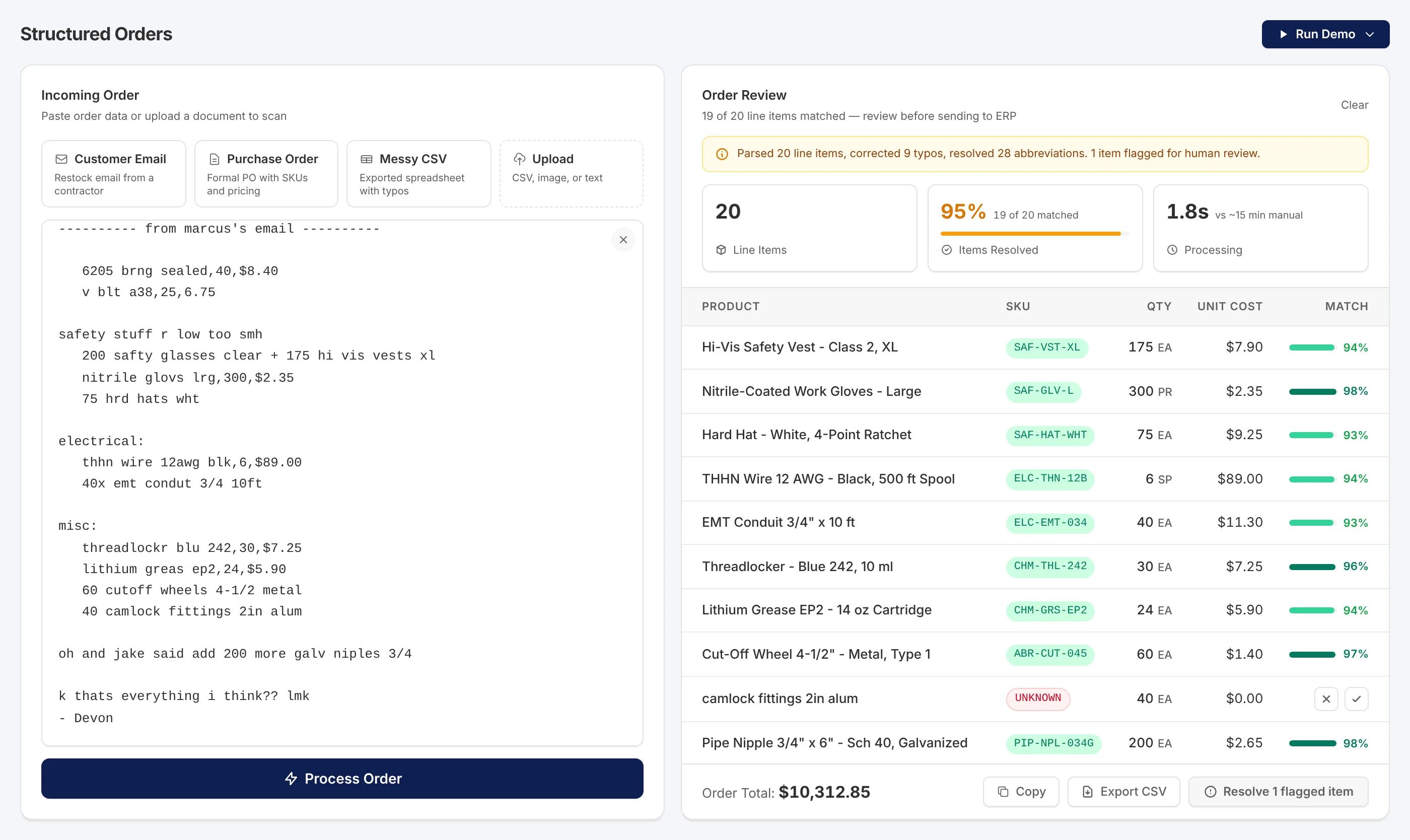
- Our agent matches each line to the catalog and flags the ones it isn’t sure of.
- The sales calls decided what we built: the one job distributors described.
The numbers
My part
- Decidedthat nothing would reach the ERP until a person had resolved every line the agent flagged.
- Ranevery sales call, the pricing and the business plan as the de facto product manager.
- Builtthe agent, from reading the order to syncing it to the ERP.
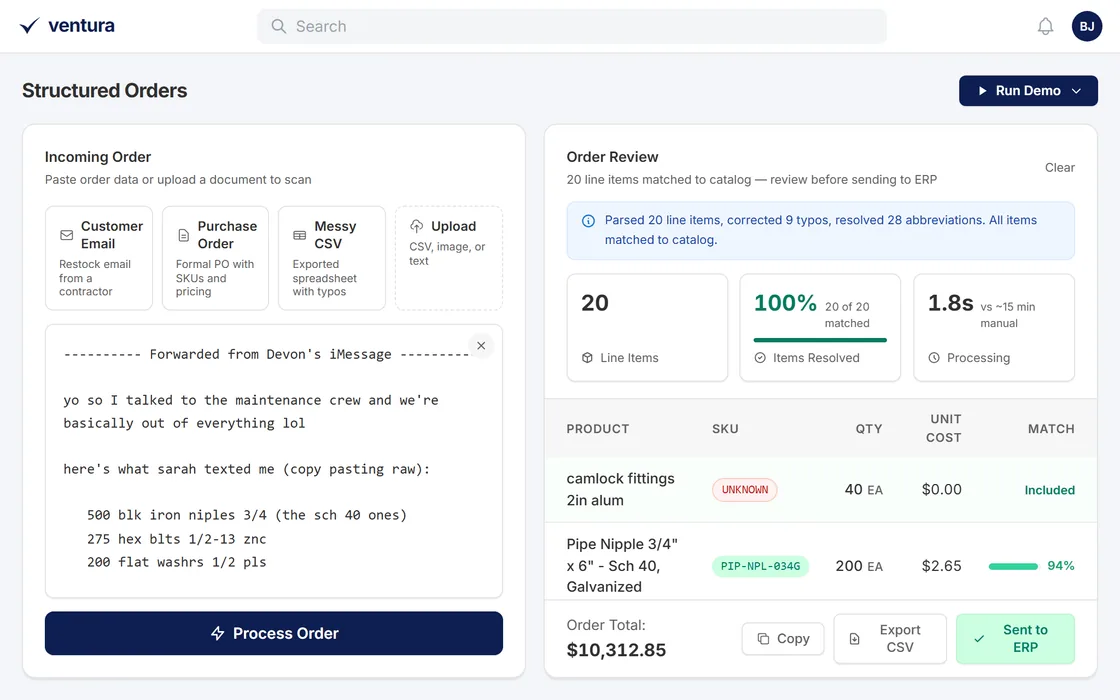
- Builtthe public demo of the review workflow, so anyone could see it without a sales call.Clean-Data
Check the two lines the machine isn’t sure of.
In
- Emailneed 20 of the 3/4 ball valves brass + 10x 1/2 npt tees
- Faxed purchase orderPO 58812: 50 HEX BOLT 3/8-16 x 2 ZN
- Counter slip6 x 2" pvc cplg, 2 x pipe dope
Matched to the catalog
- Ball valve, 3/4", brass, full port× 2097% sure
- Tee, 1/2" NPT, black iron× 1088% sure
- Hex bolt, 3/8"-16 × 2", zinc× 5099% sure
For a person to check
Two lines need a person: pick one to check it.
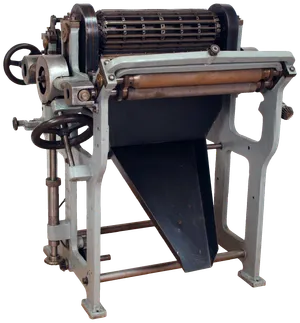
The orders and parts are made up. The order reader is a perforating machine from the Smithsonian’s National Postal Museum.
Clips
The problem
An inside-sales rep spends most of the day retyping orders, and every line is a chance to get a part number or quantity wrong. The orders are a mess: an email that says “blk iron niples 3/4”, or a purchase order scanned at an angle. The rep knows the catalog well enough to decode all of it. That’s why the job is so hard to hand to software.
From an idea to 15 paying distributors
We had one summer. I owned the outreach, the calls and the prototypes. Plenty of ideas sounded good from the engineering side, including my co-founder’s, but distributors could tell in one conversation that they wouldn’t help. I set those ideas aside and kept the job distributors described: getting the order into the ERP the way their best rep would.
By the end, the distributors thanked us. So did the reps, who had spent their days entering orders and got that time back.
Decision log
to test every sentence of our cold outreach, the subject line and the channel.
Rejectedsending one good pitch to everyone.
Whywe didn’t know the buyer yet.
Result10 percent of the people we reached answered, compared with the usual 1 to 2 percent.
to lock “Send to ERP” until a person has resolved every flagged line.
Rejectedsending orders automatically.
Whya wrong part that ships means a returned pallet and, often enough, a lost account. A flagged line costs a rep about ten seconds.
Resultthe review step became the demo.
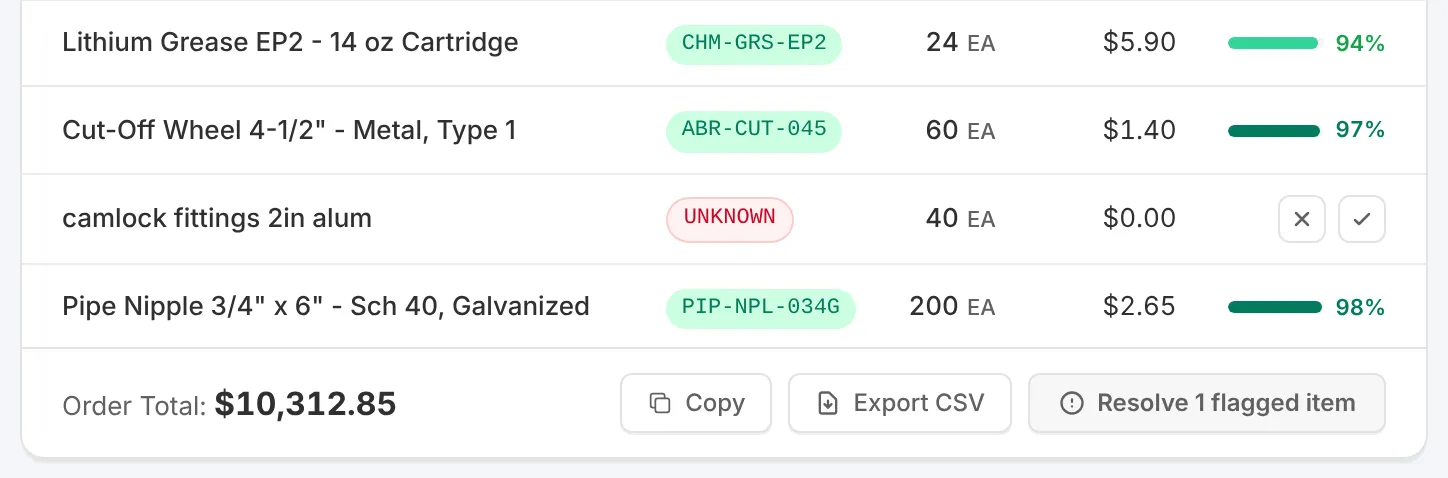
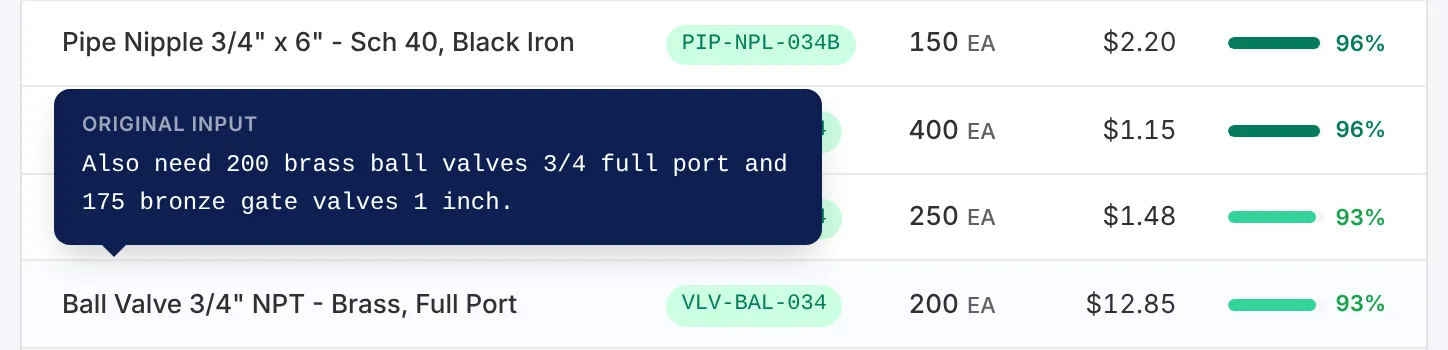
to show where each line came from: hover over it to see the original words.
Rejecteda clean table.
Whyreps needed to check the agent’s work.
Resultin the first month, reps came to trust the agent by checking those sources and finding them right.
to sell the review workflow.
Rejectedleading with the model’s accuracy numbers.
Whyevery buyer we met had heard accuracy claims. None had seen a review step designed around their own people.
Resultabout $600,000 closed in three months.
to leave pricing rules and live inventory checks out.
Rejectedbuilding a complete order-to-cash flow.
Whythe whole promise was matching lines correctly, with a person signing off on the uncertain ones.
Resultthe first version did one thing well enough that customers paid for it.
What I would do differently
I’d go in person and spend a day shadowing a distributor’s order desk, instead of relying on how people described their process. I’d also plan the summer better. The testing paid off, but it pushed the building into the last few weeks, and I pulled one all-nighter after another. I should have asked for help sooner.
What I would do next
I’d measure the two numbers a distributor cares about, before and after: the minutes from an order arriving to its entry in the ERP, and wrong part numbers per hundred lines. We had testimonials but not those numbers.
A postcard from San Francisco.
Postmarked 1951. Photograph by Hope Moore (public domain). Click or tap the card to read the note on the back.
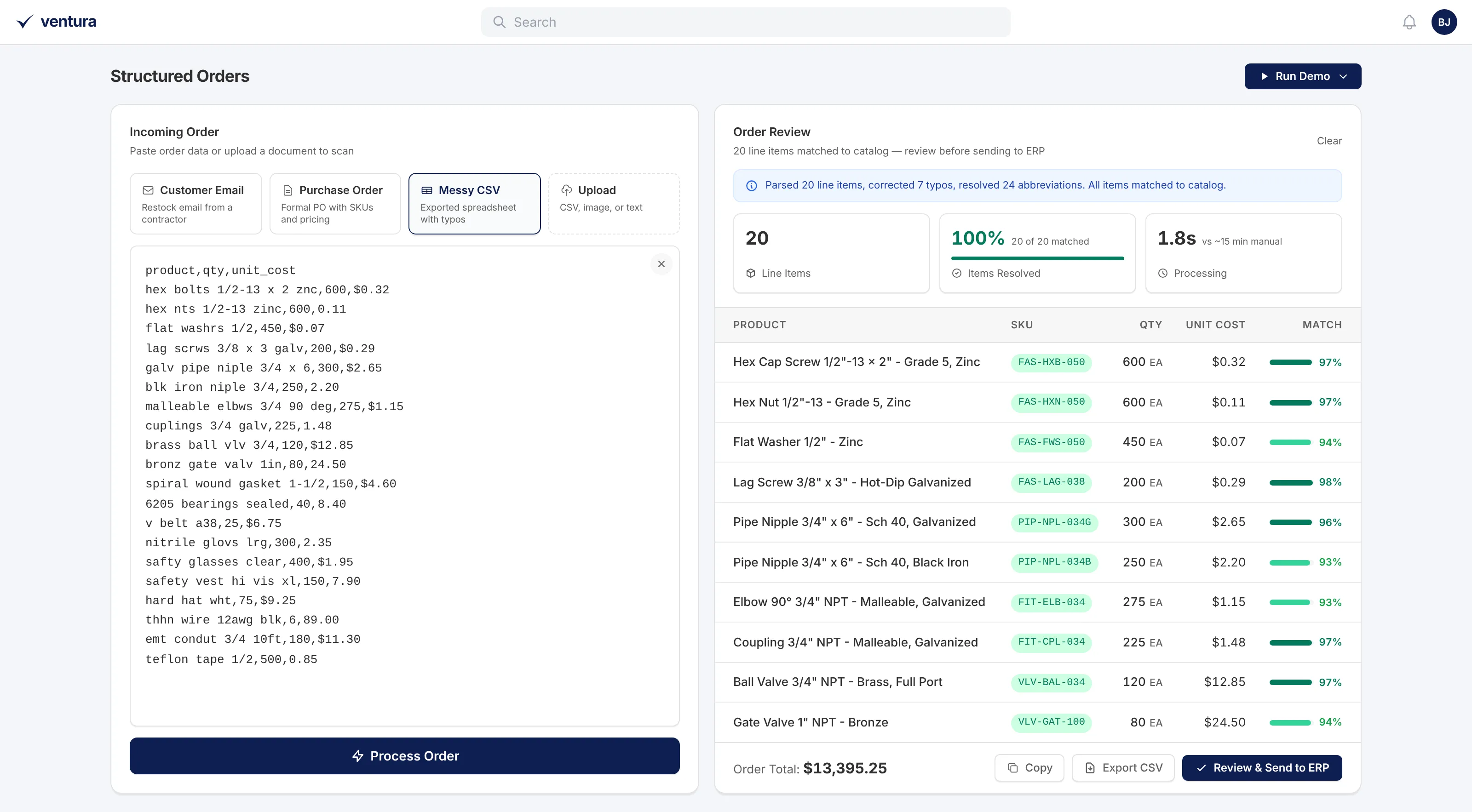
Try it: run the demo, resolve what it flags, and send the order to a mock ERP.
Go deeper
- View the Clean-Data code on GitHubMy public rebuild of the review workflow.